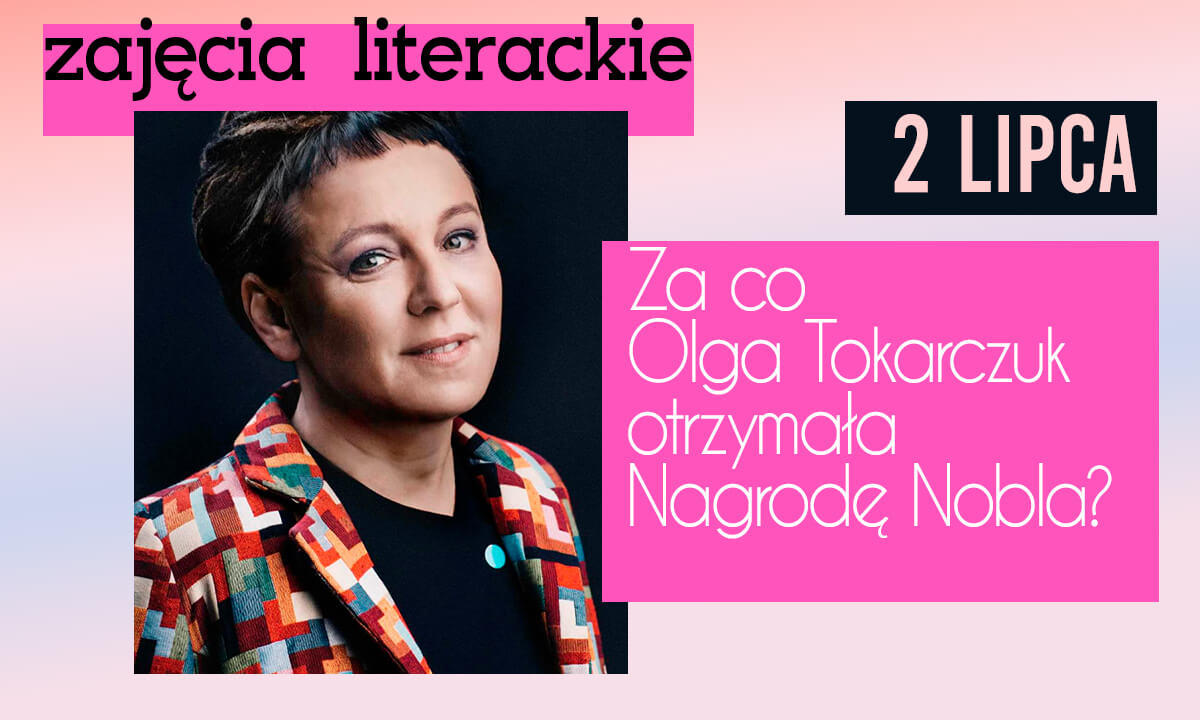
Reading articles by literary scholars and translators, and communicating with lovers of literature and poetry, one often wonders: why was Olga Tokarczuk awarded the Nobel Prize?
Anticipating objections, we note that the Nobel Prize, on the one hand, is a political phenomenon, connected with world order and geopolitics; on the other hand, it is recognition, status, and a pedestal that are important for the writer and significant for society. The Nobel Prize is a mark of distinction for a great, significant and popular writer. One can talk about many other good writers, but still, the Nobel Prize is an indicator of mastery.
The Nobel Prize is always accompanied by some philosophical formulation. For Tokarczuk, the committee formulated it this way: “For an imagination that, with encyclopedic passion, shows the violation of boundaries as a way of life.” One could put it another way: “for sensitivity to changes in the world and the accuracy of their reflection in words.”
Good writers are a kind of guide and magician, but they live more by intuition, by the senses, they catch new emerging trends and, anticipating reality, formulate them in words.
Tokarczuk's world is a collage, a mosaic, her canvas of life is viscous, ornate and honeyed. She thinks a lot about the boundaries of worlds, about male and female ways of life, about nature and man. How would you answer the question: why did Olga Tokarczuk receive the Nobel Prize?
According to the organizers, the meeting became a unique combination of a book club and a theater, imbued with a love for the Polish language and culture. Participants shared their impressions of Olga Tokarczuk's works, noting seemingly subtle details surrounding her characters and sometimes marveling at how others might think differently.
For example, while discussing Tokarczuk's story "Jars of Homemade Jam," one of the participants noted that the hats of the old women, the mother's friends, resembled the mushrooms that later poisoned the heroine's son. Another participant suggested that the unusual snacks the mother prepared in the story ‒ a sponge in tomato sauce and shoelaces in vinegar ‒ were a kind of "wake-up call" for her son to wake up from his stupor and start living differently. Participants also noted the repetition and cyclicality, regularity and logic of the story, which was reminiscent of a kind of samsara circle.
Every time while discuss Olga Tokarczuk's works, her images and characters are revealed in a new way, and an irresistible desire arises to immerse yourself again and again in the world created by the author.
However, the main hero of the evening was pan Vladislav, who prepared a surprise: he bought and gave each of the participants a book by Olga Tokarczuk. According to him, this was the "culmination" of this meeting of the literary club.
An unforgettable evening! Moments like these are what make projects, sharing, writing and working worthwhile!